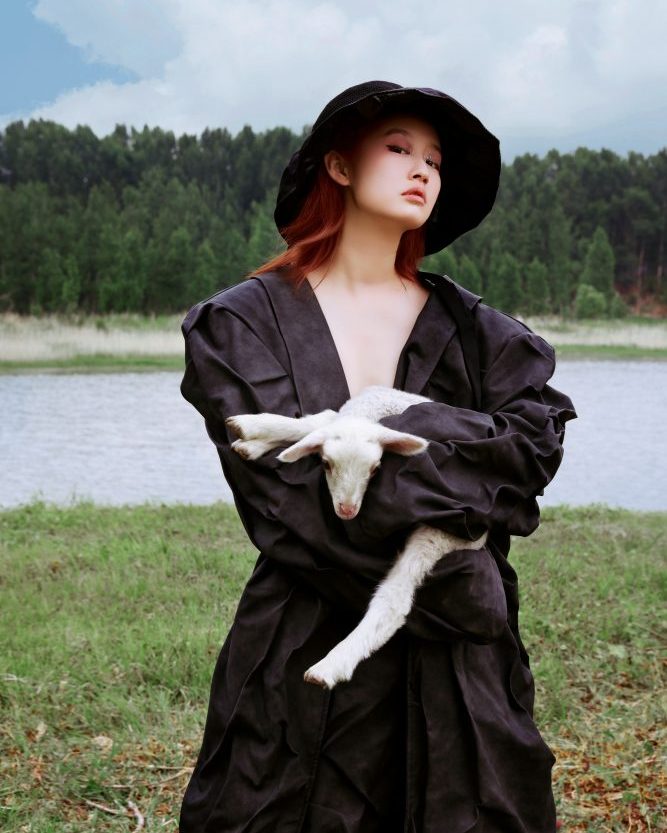
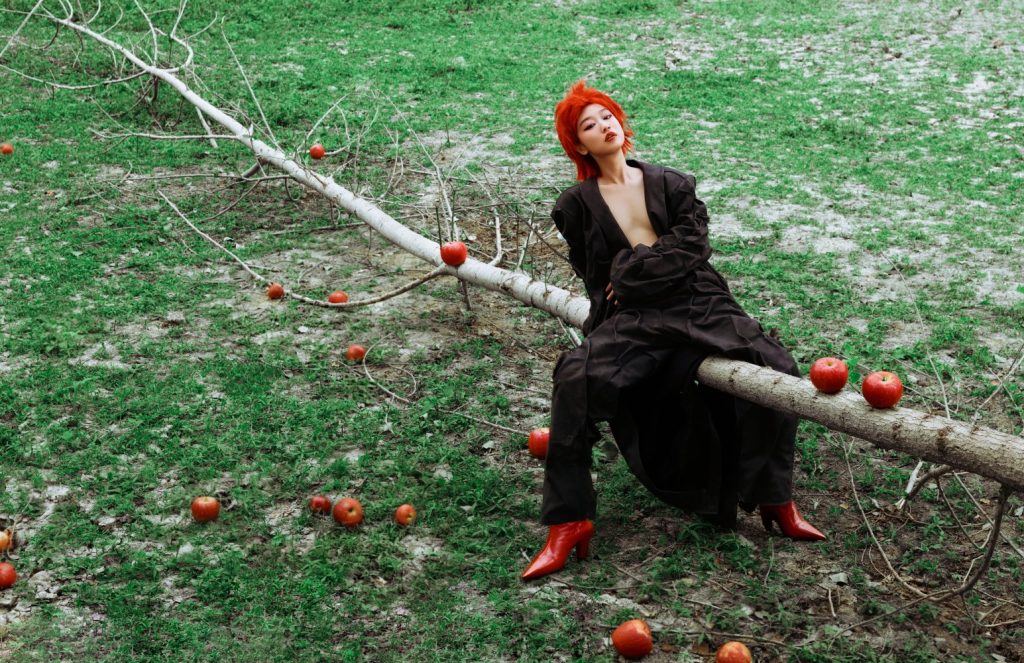
Ran Wei learned to shapeshift early on. As a teen, she relocated from China, where she was raised by her grandparents, to her parents’ established home in Burlingame, California.
In conversation with the actress, artist, and model, Reserved reveals what’s required to rewrite
“My parents came over here when I was three years old. They wanted me to learn Mandarin from my grandparents and remain in China. When I first came to America, I didn’t speak any English. It was very hard for me. I’d built a friend circle in China and attached to my family there. Because I didn’t grow up with my parents– I saw them during summer vacation, or during the New Year— I was crying and begging my mom to take me back. I was in the U.S. for one week before I started American high school, knowing no English.”
Wei’s language developed in an unorthodox manner, reaching beyond the verbal to unlock her universal truth.
“Being an artist, especially an actor, gave me more confidence. If I’m feeling uncertain, I can at least act out courage. Drawing and oil painting didn’t require speaking, so I relied on them as outlets.”
Photo Courtesy Jia Ning
While Wei’s canvas unfurled before her, autonomous ambitions pushed the artist into industries she never expected to grace, ultimately unlocking her otherworldly ability.
“I wanted to get away from my strict mother— she always had high standards for me— so I got a part-time job to get acclimated to American society. I worked at a Cinemark and a clothing store in the same mall at the same time. During my lunch break, this woman scouted me as a model.
I pictured a runway model: six feet tall with a strong aura. It wasn’t me. I’m 5’4”, and I didn’t think I was interesting looking enough to make it. She gave me her card, insisting I’d be able to book jobs. As I was walking home, a Russian man pulled next to me. He was an entertainment agent in San Francisco. Two signs in one day felt like a sure bet, and I called the woman.”
That initial agent’s instinct paid off instantaneously, as Ran booked the first gig of most actors’ dreams.
“My first audition was for Apple. They were looking for real artists, so I was booked on the spot. They were generous. I had no idea what the industry was like, but I knew that was better money than you make oil painting. I started playing around in the film world, and found more of an ability to build a relationship and depth with a character. That prompted my move to LA, because there are bigger opportunities.”
Though, Ran’s runaway success is no surprise, given a genetic trend of film affinity, and her early touchstones in Chinese entertainment.
Photo Courtesy Jia Ning
“My dad was a filmmaker and had a commercial agency back in China. He did documentaries and had an art background. Since I didn’t know what I wanted to do with my life, I thought maybe I’ll just copy my dad’s for now.”
Her developed passion has since rooted in a proclivity, as much as an old familial grudge, Wei jokes, recalling:
“When I was three years old, my dad had a spot with a candy brand in China, where he was looking for a child to sing a song alongside an old man. My mom suggested he hire me, but once I was on set I could not get the lyrics right. He fired me on the spot.
He had two rebound kids on set and replaced me before my eyes. My mom told me later that he said I could never become an actress. Really, I love doing this. But, a small part of me really wanted to prove it to him (laughs).”
In a sea of individuals unwavering in their silver screen dreams, Wei’s unshakeable conviction and commitment to her craft sets her apart. She shirks any idea of typecasting, instead insisting to be seen as herself above all else, and everything that can encapsulate.
Photo Courtesy Jia Ning
“I played a fashion boss, a sort of Devil Wears Prada type. The casting called for a caucasian woman in her 40s. But, when I signed with my commercial agency, I told them as long as the personality fits, please send me there and I know I can book the job. It doesn’t just have to be “Sushi Girl Number One”. When I got to the audition, I got into a disagreement with the session director, too, since he wanted me to play it a certain way. There were 200 other women waiting outside who would be playing it that way, so choosing to be different and sticking to my gut booked me the role.”
When asked from whence this methodical individualism sprouted, Wei blithely explains:
“I didn’t grow up here, so watching the best films of my adolescence, I didn’t have an idea of me being different— Asian or Chinese. People that grow up here have that implanted in their heads from an early age. I instead thought about humans in general. Watching films, I’ll begin thinking of the way things are being acted and the different choices I’d make, the way I see myself visually within that film. I’m confident in storytelling from my perspective. Nobody has told me “no” before, regarding my acting choices. The most I’ll hear from my acting coaches after a bold move is ‘Oh, interesting.’”
As it seems Wei is dexterous enough to manifest her dream role, it begs the question what that casting may be.
“I’d love to explore a Fifth Element type of role. I’m often booked in futuristic or Ai parts, and the wider genre of sci-fi really resonates with what I want to be creating. You’re enabled to be limitless in your character.”
Photo Jia Ning
If she were to be pigeonholed, Wei relishes in the relief that she’s often delegated as the plot’s most complex character.
“For some reason, I’m always cast as the villain. I really enjoy it, because you can explore human nature. Villains are unpredictable, and the audience is able to understand why. One of my favorite parts was playing an unhinged wealthy woman, for a commercial. I arrived at the audition where everyone was in their richest clothes. I was in a robe with half a bottle of wine. If you’re rich, you don’t give a shit how you look.”
Despite her initially illustrious IMDB entries, a recent SXSW feature and a stream of stereotype-busting offers have no shot at slowing Wei’s vigor.
“Nowadays, I’m still in the same space– hustling and auditioning every day. I’ve been training MMA three to four hours a day to prepare for an action feature that my agent wrote for me. I also have a video game role coming up, as a fighter. I’d love to be a badass female hero that can save the planet. It sounds so cringey, I know.
Every time I play a different part, they stay inside me. I get to channel them whenever I want. It’s like you have many different outfits. I feel like nothing is really a big problem, because I lived so many lives playing different parts.”