Niia has shaped her career through patient defiance. She’s rigorous about her work, uninterested in trends, and unafraid of contradiction, both deeply introspective and disarmingly irreverent. The authenticity with which she presents herself is refreshing, allowing her to carve her own path in the music industry.
With a foundation in jazz that quickly expanded to R&B and pop, Niia’s approach to genres opened a path to experiment, while avoiding easy categorization. Now, she has returned to her musical origins. Stripping away the polished image that has recently been associated with this genre that, at its core, is rooted in rebellion and self-expression. She explores its limits, bringing it to a contemporary light.
There is a sharpness to the way she speaks that mirrors her music: eloquent, instinctive, yet unfiltered. Our conversation felt as natural as catching up with an old friend, moving between her inspirations, her latest album, and her evolving perspective on music and style.
You grew up surrounded by music. What made you decide to specialize in jazz?
I started in classical piano, but my mom realized I wasn’t playing what was on the page, so she put me in jazz. It was a bit freer. Growing up, all my peers were into pop or musical theater, but my voice was always a bit lower. When I was about 14, my mom gave me a Sarah Vaughan record, she had a really low, beautiful voice and I was hooked forever. I could not get enough jazz, or of all these women singing sad, emotional ballads.
Recently, what drew you back to it?
As I’ve gotten older, I don’t really give a shit what people think I should make or what the trends are. I just want to make music that I love and keep pushing myself. Jazz is the hill I really want to die on. It’s always been my first love. I wanted to see if I still could do it, and still love the genre. It felt like, “Whoa, I missed this.”
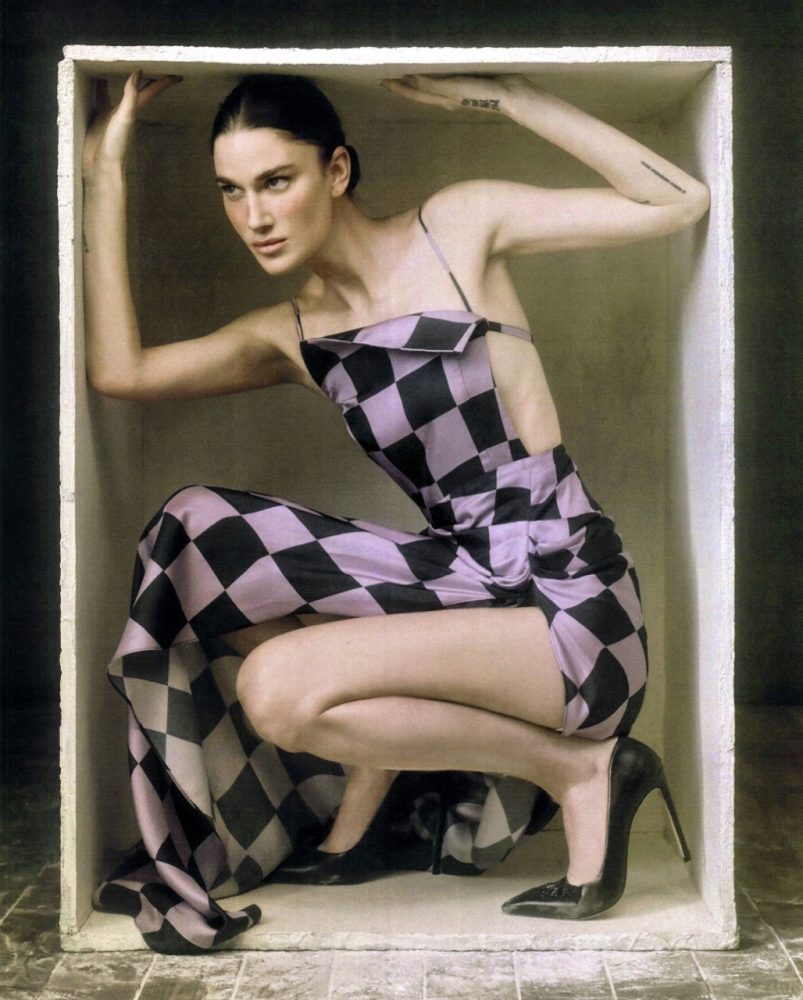
NIIA Photographed by Szilveszter Makó.
You’ve said that your fifth studio album, “V” doesn’t have a concept. It feels more like it became a self-portrait. You’re giving us intimate glimpses into your mind– a collage of things that move you. Can you touch on where some of those glimpses might take us?
It wasn’t intentional to hold a mirror up, it just happened because I didn’t want to box myself in. Growing up, so many jazz standards were about heartache or self-realizations, or were like, “the world is on fire,” these big, dramatic statements that are really metaphors for something else. I’ve always loved those cheeky jazz lyrics from back in the day. So I wantedto make something that felt serious, but still had some humor to it. That’s who I am. I’m deep and intense, but I’m also funny and silly.
I didn’t want it to sound like an old jazz record or a throwback. I wanted it to feel like it’s from the future, and not be all about the singer. The music is advanced, I wanted the players to have some moments.
It feels like jazz under your own terms, very contemporary. I know the creation of this album wasn’t linear, you wrote on Instagram that you started to work on the song “Dice” in 2019, and came back to it. Can you tell me about your creative process when starting a new project?
I really sit with my projects, I let them marinate. “Dice” didn’t fit with where I was at the moment, but when this album started coming together, I was like, okay, it’s time to finish it. It just reveals itself. I only work with a small circle of writers, because they know my rhythm, I’ll show up, and then disappear for four months. But also, I’m not 20 anymore. If I sing about something, I have to really feel it, experience it, and believe in it. I have to stand by what I say, even if they’re fucked up things, or if it’s something I’m still figuring out. It’s committing to writing with brutal honesty and then sharing it with the world. And honestly, I don’t think I know how to make music any other way. When it comes to what I’m singing about, it has to be real.
You consider yourself a really introverted person. Is it hard or scary to be this publicly vulnerable?
I think it comes after. I kind of black out, I’m so laser-focused on what the work calls for and I feel like I have to be violently vulnerable or the song sucks. And then after I’m like, “Oh boy, my mom is going to hear this.” Sometimes I wish I made that connection a little bit sooner but also, I’m happy I don’t, because it would hinder what I write.
NIIA Photographed by Szilveszter Makó.
What is your relationship like with your audience? I know you tend to leave things open to interpretation, but is there a particular way you hope people experience your music?
These days, a tracklist is a lost art. I try to build mine in a way that you could listen to in order. But it’s hard to explicate your work. I’d rather people listen to it and take their own experience from it. Each song becomes what it needs to be for whoever’s hearing it, and I love that.
When I’m performing my relationship with my audience has transformed. I used to really ignore them, to the point where I would close my eyes and disengage. I didn’t want to see anyone out there because being on stage is a lot of power, you’re amplified and elevated, looking down at everybody. It can turn into something that feels a little too close to a God complex, which just isn’t for me. But I’ve learned that everyone there is showing up to share this moment and connect. So I’ve had to take my ego out of it and think of myself more as a vessel for that connection. Whether it’s me or the songs, it becomes this shared space, and that feels really special. It’s not really about me anymore. I’m embracing my relationship with my audience because I’m grateful for them.
The album cover is striking and very symbolic. Can you tell me about the heretic’s fork and what it represents to you? Is it about rebellion, silence, or something else entirely?
It’s a bit of both. On one hand, I feel like jazz has been visually watered down over time. When I was growing up, a lot of those artists felt raw, chaotic, even dangerous. The jazz era was pretty fucked up in the best ways. They were kind of hardcore punks to me. But somewhere along the way, we created this really safe, almost sterile image of jazz, like it’s only for older audiences, or it’s just a woman in a gown leaning on a piano. I didn’t want to play into that. I wanted to say, “fuck you, this is jazz too. ” The cover needed to be sexy but also to mean something. So to your point, the heretic’s fork was used as a torture device, often to punish women who were outspoken. And I have some shit to say. I want to shake up what jazz is for women, especially as a singer.
NIIA Photographed by Szilveszter Makó.
Creativity is, of course, fed through many mediums. Apart from music, what inspires you?
Film inspires me so much. I grew up on incredible Italian cinema. Books, I love reading. A lot of old weird poets and strange novels by mentally ill women are usually my favorite. And fashion has always been interesting to me, I’m finding new ways to express myself, trusting the people around me who are constantly guiding and teaching me. For a long time, my style was very functional, I’d wear black, slick my hair back, and that just made sense. But now I’m starting to see the expression behind it, and that I can take more risks and be a bit braver with it.
Can you tell me more about your personal style?
I’m still figuring out how to exist in a world where often it feels like everyone’s very extreme, I mean we’re all fighting for visibility these days. But there are people carving their way in a very quiet or elegant way. So, I try to look at artists, actors or musicians whose style feels authentic.
At the beginning of my career, when I would show up in a suit with my hair back, people would be like, why aren’t you wearing a dress? Wearing pants felt revolutionary, nobody wanted me in pants for a while. The music industry is very overly sexualized and pushes the agenda with what women should be wearing. But no, I want to take more chances in both areas. It’s fun to be really sexy and play on being a woman, but also, I love Tilda Swinton and Cate Blanchett, sometimes they look even sexier when they’re wearing androgynous things.
Like you, I grew up between two cultures, and I think that experience can create a particular sensitivity. How has that shaped the way you see the world, and how does it translate into your creative language?
My mom’s from Italy, so I was the kid bringing lasagna in a Tupperware while everyone elsehad a ham sandwich. Those little things shape you. They change how you see the world. I also grew up around a certain amount of shame about where you come from and how you fit in, and I’ve carried some of that with me. A lot of my work has been about unlearning that and finding ways to empower myself, to own it.
But overall, it’s shaped me for the better. It’s made me more open, more curious. I have good taste, I know how to cook, I know how to connect with people. And getting to experience different cultures, especially through touring, has been huge for me. Travel is such a privilege. It teaches you humility, it expands you, and learning about other people’s worlds is vital. Right now, people are afraid of others in such a weird way. We are watching what everyone is doing, but we’re not actually taking it in, or seeing how we can grow from it.
Being exposed to different ways of living is so important. It makes you a better person, you understand why we’re all here to some degree. Or even if you don’t, we’re all here and we’re all very fucking different, and there’s no reason for that to be scary.
You’ve said that artists shouldn’t stay in one lane, and that experimenting– even failing– is part of the process. As you look ahead, what feels most exciting or unexplored for you right now?
I’m working on a book of short stories. I love writing lyrics and poems, but I want to take a dive into the literary world and see what happens. Potentially, and hopefully write a book. And of course, more albums, I’m going to stay making jazz for a minute, see where else I can push it.