Archive Givenchy by Riccardo Tisci top, Capsule Eleven necklace, and Oakley glasses.
Looming from the shadows of Los Angeles’ underground, John Bryars has spent years honing into his craft as a DJ/Producer. Now he is stepping into a defining new era with the release of Invariant, a four-track EP that also inaugurates his imprint, Aeonic Forme. Known for conjuring high-intensity sonic environments that blur the line between physical release and emotional escapism, Bryars has steadily built a reputation as one of electronic music’s focused new voices. With Invariant, he sharpens that vision into something even more precise, a transmission designed not only for the dance-floor, but for the interior landscapes listeners carry within themselves.
The EP unfolds as a deliberate arc, moving from propulsion to pressure to catharsis. Across its runtime, Bryars channels techno, acid, EBM, and industrial into a unified force, culminating in “Remove Fear,” a closing meditation built around the voice of Genesis P-Orridge of Psychic TV. The moment feels less like an ending than a clearing, dissolving tension and inviting transformation. It reflects Bryars’ deeper ethos, that music is not static, but constantly evolving alongside identity, community, and culture itself.
The release arrives at a pivotal moment. Following acclaimed work with Boys Noize Records and a growing global presence, Bryars recently made his New York debut, including a closing slot at Basement NYC and a session on The Lot Radio. These milestones mark more than geographic expansion; they signal the emergence of Aeonic Forme as a platform for radical expression and Bryars as an artist shaping the future contours of underground electronic music. Below we catch up with him to capture a sense of his amusements.
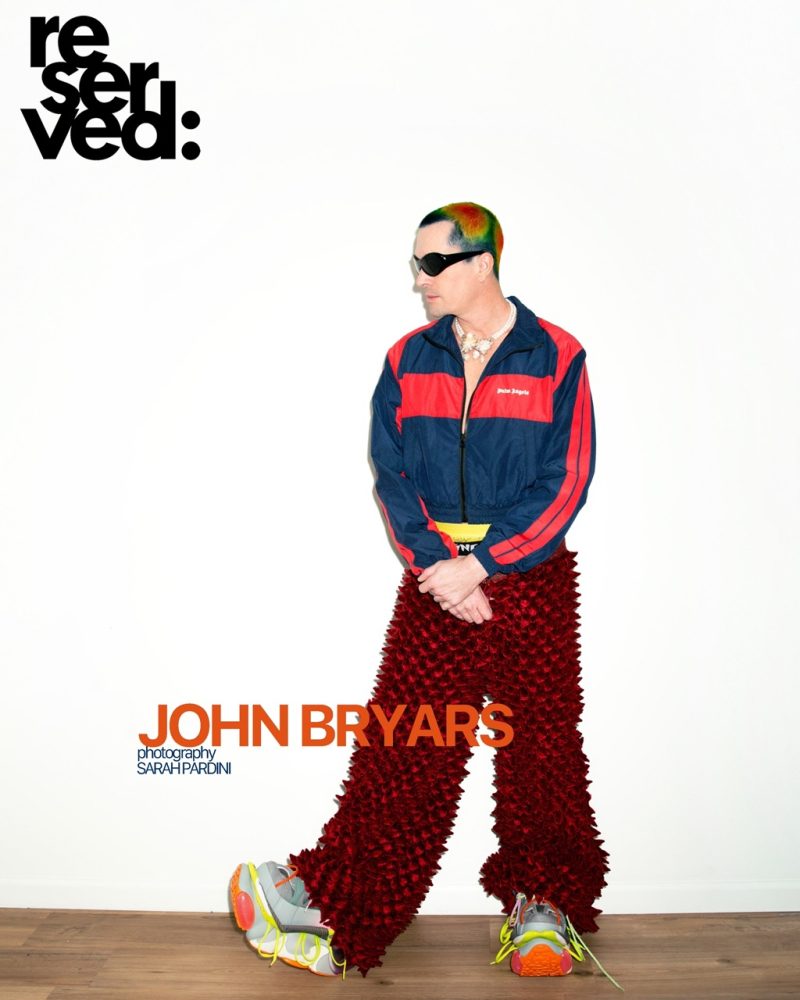
John Bryars wears Better With Age jacket and pants, Palm Angels top, Vooglam x TOMBOGO glasses, My Dearest World necklace, Capsule Eleven necklace and Loewe shoes.
John Bryars wears Better With Age jacket and pants, Palm Angels top, Vooglam x TOMBOGO glasses, My Dearest World necklace, Capsule Eleven necklace and Loewe shoes.
John Bryars wears Better With Age jacket and pants, Palm Angels top, Vooglam x TOMBOGO glasses, My Dearest World necklace, Capsule Eleven necklace and Loewe shoes.
John Bryars wears Better With Age jacket and pants, Palm Angels top, Vooglam glasses, My Dearest World necklace, Capsule Eleven necklace and Loewe shoes.
John Bryars wears Better With Age jacket and pants, Palm Angels top, Vooglam x TOMBOGO glasses, My Dearest World necklace, Capsule Eleven necklace and Loewe shoes.
You just closed Basement NYC and played Lot Radio for the first time, both major moments. How did you approach your NYC debut differently from other shows?
New York felt deeply affirming. I’ve always believed in intention and for a long time I told myself the only reason I would go there was to play Basement NYC. That clarity shaped how I prepared. Closing the room for Bound’s nine-year anniversary meant building long arcs for a crowd that truly commits until the end. I’m deeply grateful to Katie Rex for the trust and to the Basement team for holding that space with such care. The Lot Radio offered a different kind of intimacy. I tested unreleased material including tracks from Invariant and focused on flow and density rather than peaks. Feeling that energy land in real time with a New York audience was deeply meaningful.
Basement has a reputation for intensity and focus. What kind of energy did you want to leave behind in that closing slot?
I wanted to leave behind a sense of release and completion. I moved through contrast, dark moments, bright moments, and acid pressure. without staying in one place too long. I ended with my ambient track “Remove Fear.” That felt right. It allowed the room to exhale and close with grounding rather than impact.
Lot Radio captures a different kind of intimacy than a club. How do you translate your sound and philosophy into that format?
Lot Radio invites a different kind of listening. It’s more intimate and less about impact in the traditional club sense. I translate my sound by leaning into flow and density. In an hour I might fit close to thirty tracks weaving together moments I’ve dug for over time. Sometimes there are so many ideas I want to include that the challenge becomes making them coexist. The philosophy stays the same. Trusting instinct shaping momentum and letting curiosity guide the set while allowing listeners to experience the music up close rather than from a distance.
Invariant launches Aeonic Forme as both an EP and a statement. Did the music come first, or did the vision for the label shape the record?
The music came first. Invariant began as a personal body of work, and as it developed, it became clear it needed a larger framework. Aeonic Forme emerged to hold that intention. The EP didn’t follow a label vision. It defined it.
The EP traces a clear emotional arc from ignition to release. How intentional was that narrative when sequencing the tracks?
Very intentional. I thought in terms of movement and pressure, how energy builds, holds, and dissolves. Each track represents a state, and the sequencing guides the listener through those shifts naturally. That approach comes from studying painting at the San Francisco Art Institute, where the focus was on structure, intention, and process rather than surface. By the time the closing track arrives, the tension dissolves instead of exploding. The record exhales rather than ending abruptly.
John Bryars wears Vintage Vivienne Westwood top and pants from Pechuga Vintage.
John Bryars wears Vivienne Westwood jacket and pants from Pechuga Vintage and D&G shoes stylist’s own.
“Entrance” feels like a literal threshold moment. How were you hoping to frame listeners into the project?
Entrance was meant to draw listeners into the world through weight rather than announcement. The low end grounds instead of overwhelms, creating a sense of crossing into a heightened state where focus sharpens and the body locks in. It’s not rushed or explanatory. It’s immersive and deliberate.
You end the record with “Remove Fear,” which reframes fear as a choice rather than a fate. Why was that the right way to close?
Ending with Remove Fear felt essential. I wanted the record to release weight rather than add more. That perspective comes from the queer communities I move through, where courage and openness exist alongside vulnerability. It also mirrors the creative process itself. Releasing work means letting go of fear and choosing trust.
You sampled Genesis P-Orridge on “Remove Fear.” What does that lineage of transgression and transformation mean to you?
Sampling Genesis was about honoring a lineage that shaped me. Through Psychic TV, that work opened space for transformation long before it was widely understood. Including that voice wasn’t about nostalgia. It was about gratitude and acknowledgment of trans and gender-nonconforming pioneers who reshaped culture through courage.
You’ve said the challenge isn’t making the work but letting it go. What fears surfaced while releasing Invariant?
The fear wasn’t about exposure. It was about release. Letting the music go and allowing it to exist without holding onto it. Invariant became a way of practicing that. Releasing fear control and attachment all at once. Starting the label was tied to the same gesture. Trusting the work enough to let it move on its own. In that sense the fear wasn’t something to overcome but something to loosen.
John Bryars wears Better With Age top, Leeann Huang top, Palm Angels shorts, Vooglam x TOMBOGO glasses, Grounds shoes
John Bryars wears Better With Age top, Leeann Huang top, Palm Angels shorts, Vooglam x TOMBOGO glasses, Grounds shoes.
John Bryars wears Grounds shoes and My Dearest World necklace.
John Bryars wears Vooglam x TOMBOGO glasses.
John Bryars wears Vooglam x TOMBOGO glasses.
Aeonic Forme is described as less a label and more a living system. How do you imagine it functioning beyond traditional release cycles?
Aeonic Forme isn’t built around output or fixed cycles. It evolves through moments rather than schedules. Each release visual or gathering carries as much weight as the music itself. The system shifts form intentionally without chasing pace or hype. That approach is why collaboration matters so deeply. Working with WickboyX reinforced that idea. He listened closely to the music while creating the visuals and that dialogue is present in the work. The visuals aren’t decoration they’re structural. That level of care and trust allows the world to expand beyond sound. Aeonic Forme functions as a long-term living system shaped by shared authorship and attention.
How does that philosophy show up differently in your DJ sets versus your productions?
In DJ sets, it’s instinctive. I move fluidly across tempo and texture and let emotion lead instead of genre. In production, it’s structured and focused on restraint and gradual evolution. They come from the same place. One is immediate, the other introspective.
Launching the label with your own EP is a bold move. Did that feel vulnerable?
Yes, It meant placing myself fully inside the identity of the label. There was vulnerability in making the first statement personal rather than curatorial, but it felt honest. If Aeonic Forme stands for clarity and trust, it made sense to begin with my own voice.
After releasing on other labels, how does putting music out on your own imprint change things?
It brings everything into focus. Before, I was working within shared frameworks. With Aeonic Forme, I can realize my vision in full. That freedom also carries responsibility. It opens space to think beyond releases toward community projects supporting LGBTQ voices and causes like immigration justice.
John Bryars wears Palm Angels top, Gert-Johan Coetzee pants, Grounds shoes, Fucking Awesome underwear, aWd sunglasses, My Dearest World necklace.
John Bryars wears Palm Angels top, aWd sunglasses, My Dearest World necklace.
John Bryars wears Palm Angels top, Gert-Johan Coetzee pants, Grounds shoes, Fucking Awesome underwear, aWd sunglasses, My Dearest World necklace.
John Bryars wears Palm Angels top, Gert-Johan Coetzee pants, Grounds shoes, Fucking Awesome underwear, aWd sunglasses, My Dearest World necklace.
Aeonic Forme speaks about voices at the margins shaping the center. How do you decide which artists or sounds to amplify through the label?
It starts with listening and recognizing the authority already present in voices at the edges. Aeonic Forme centers LGBTQ artists, people of color, and others whose identities have shaped culture without being centered by it. The goal isn’t to frame those voices but to let their work speak with full weight. I look for artists whose sound carries both lived experience and clarity. The margins don’t move toward the center. The center shifts.
Your sets are often described as high-intensity and immersive. What do you want people to feel when they leave?
Release. With so much fear circulating, the club can become a temporary shelter. I want that intensity to move pressure through the body rather than trap it. If someone leaves feeling lighter and more connected, the set has done its work.
Looking beyond Invariant, what does the world of Aeonic Forme look like this year?
Looking beyond Invariant, the world of Aeonic Forme grows through intention rather than scale. The work unfolds as a continuum rather than a focal point. Projects emerge selectively and expand the world outward. Each one is deliberate. Treated as its own environment shaped by sound visuals and shared moments.
Photographed by Sarah Pardini.
Styled by BJ Panda Bear.
Hair by Leon Yeshua.
// Featuring:John Bryars// Author:BJ Panda Bear// Photographer:Sarah Pardini// Stylist:BJ Panda Bear