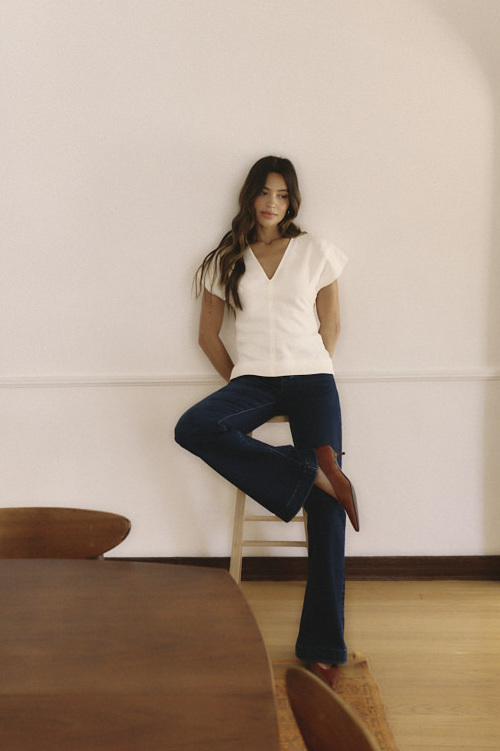
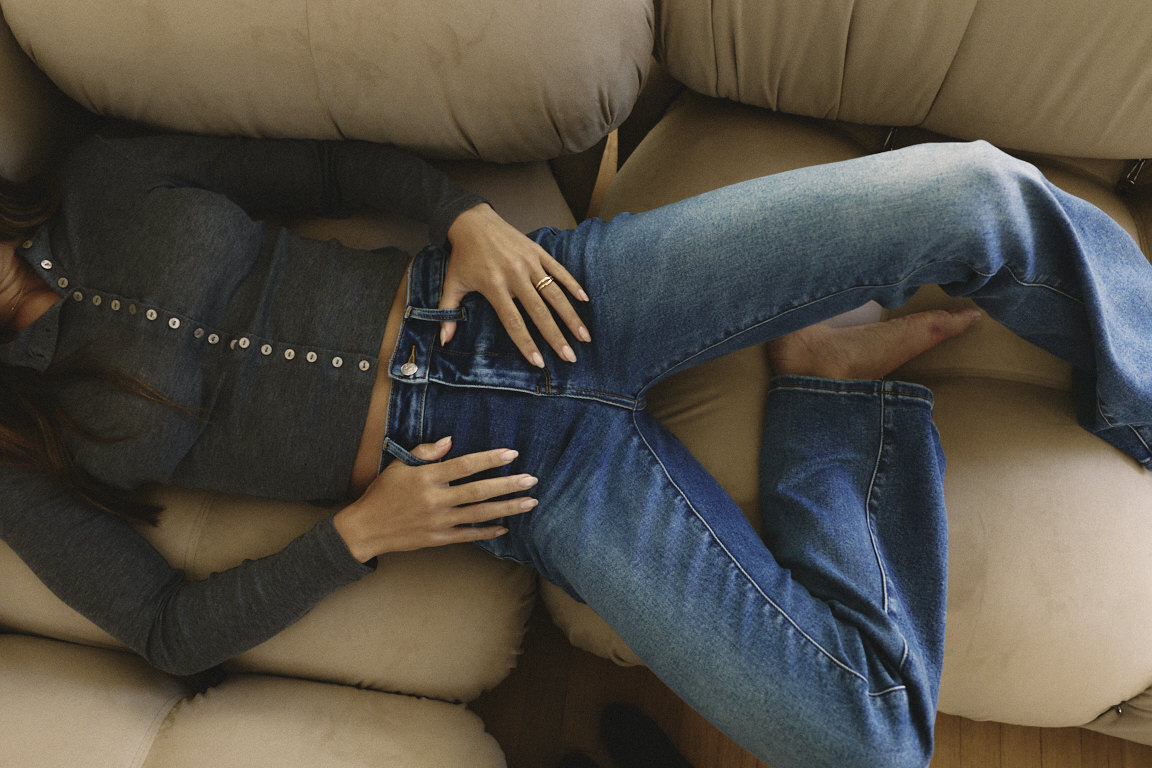
Seasoned denim designer and creative director Christina Choi has nearly 20 years of industry experience. A generational denim expert, she has built her career around creating thoughtfully designed, size-inclusive denim for women, ranging from sizes 00 to 24W.
Raised in a Korean American family with immigrant parents who built their own business in Los Angeles’ Fashion District, Christina’s connection to fashion began at an early age. After earning a BA in Business from the University of California, Irvine, she initially entered the industry to support her family’s business but soon discovered a deeper passion for solving both business and industry-wide challenges.
What inspired you to create an inclusive denim line that covers sizes 00 to 24, and how did that shape your design process?
With nearly two decades of experience designing denim for women of all sizes, I recognized a significant gap in the contemporary and premium denim market: truly size-inclusive denim that doesn’t compromise on quality, fit, or style. While many brands speak about inclusivity, it often feels like an afterthought. You can see it in their marketing, where a limited range of body types is represented, and in their product assortments, where not every style is available across the full size range. To us, true inclusivity means ensuring that every woman has access to the same designs, regardless of size. That philosophy has shaped our entire design process. We are committed to fitting and refining every style on a diverse range of models throughout development, ensuring consistency in fit, comfort, and performance from size 00 through 24. Inclusivity isn’t simply a marketing message for us, but a foundational part of how we design, develop, and bring our denim to life.
How do you balance premium denim quality with accessibility in price and fit across multiple silhouettes and washes?
We’ve been able to pull this off by utilizing relationships with factories that allow us to provide multiple sizing and silhouettes at a competitive price without sacrificing fit and quality. Keeping washes simple yet elevated with laser technology for whiskers and sanding has also been impactful for our pursuits. We’re also incredibly mindful of inventory and not overproducing.
Can you walk us through the fit philosophy behind your core offerings (skinny, straight, bootcut, wide leg, slim, flare) and how each style accommodates a range of body shapes?
Our team designed and researched with the intention on offering classic core silhouettes for a wide range of sizes and bodies. This is possible by testing a variety of denim with various stretchabilities that will work across our core offerings. By offering a range of silhouettes, it provides options for the customer to gauge which classic style is best for their body.
What role does the Los Angeles origin story play in your designs, materials, and branding for this collection?
My family’s love for denim began nearly three decades ago in the heart of Los Angeles, with humble beginnings selling at local swap meets. At the time, Los Angeles was the denim capital of America, and that environment played a significant role in shaping my understanding of the industry. Early in my career, I had the unique opportunity to experience every stage of denim production firsthand. Because so much manufacturing was done locally, I could regularly visit sewing factories, wash houses, and dye facilities, gaining an invaluable hands-on training that simply isn’t as accessible today. With most denim production now taking place overseas, it would be difficult for someone entering the industry to have the same level of daily exposure. That experience is a big part of why Los Angeles remains so meaningful to me. It instilled a deep appreciation for craftsmanship, innovation, and the people behind the product. These values continue to influence our designs, materials, and brand today.
Tees and tanks are part of the debut range too — how did you approach pairing these basics with denim to maintain a cohesive aesthetic for diverse bodies?
We found that there is a void in the premium t-shirt market for different body types. We wanted to develop great fitting tees at competitive pricing. We spent great time fitting on different body types to ensure both t-shirts and denim are at premium quality. Our tees/tanks and their fabrics are produced in Los Angeles.
What challenges did you face as a woman-owned, designer-led brand in bringing this size-inclusive concept to market, and what lessons would you share with emerging designers pursuing inclusivity in fashion?
As a designer-led brand, our natural instinct is always to create beautiful, thoughtfully designed pieces and offer them in as many styles and sizes as possible. The creative vision is often the easy part. The greater challenge is bringing that vision to life from a merchandising, inventory, and operational perspective. Building a truly size-inclusive collection was not easy because every additional size represents a unique SKU, requiring greater investment in inventory, forecasting, production planning, and fit development. To the customer, it may look like a single pair of jeans, but behind the scenes, offering sizes 00–24 means managing a significantly more complex business model. Despite those challenges, we felt it was important to commit to offering every style across our full size range rather than limiting certain designs to select sizes. We believe women of all sizes deserve access to the same fashion choices, quality, and fit, not a separate or reduced assortment.
The lesson I would share with emerging designers pursuing inclusivity is that inclusivity has to extend beyond design. It is easy to embrace the idea creatively, but true inclusivity requires commitment across merchandising, production, inventory planning, and fit development. Those operational decisions may not be the most glamorous part of fashion, but they are often what determine whether an inclusive vision becomes a reality.
My advice is to learn and respect the business side of fashion as much as the creative side. A great design means little if you cannot successfully bring it to market. The strongest brands are the ones that find a way to balance creativity with the operational discipline required to support it.
Written by Jules Wood
// Featuring:Christina of DE: Part Denim// Author:Jules Wood