Multi-disciplinary recording artist Wendy Bevan transports listeners to another plane with her second studio album, Alone With the Unknown, released September 18th. Bevan’s rich soundscape envelops audiences in her unique brand of dusky wonder, a vision deepened by her intentional direction of the album’s cinematic accompaniments— both sweepingly referential and wholly inimitable. Her recent single, ‘Fragile Times’ (produced by Duran Duran’s Nick Rhodes), is informed by Maya Deren’s Meshes of the Afternoon, the avant-garde short thriller of 1943. The fertile source from which Bevan harvests content is no performance— though a penchant for the stage pulses through her veins. Instead, Bevan is the product of an omnigenerational cultivation of taste, procured by her turn-of-the-century, English bohemian ancestors. Perhaps this is how Bevan manages to eclipse temporal context in her lyrics, to deliver audiences firmly into a noir fairytale, both eons old and yet-to-pass. In Alone With the Unknown, this epoch’s gothic priestess persuades us into her ethereality, prying open the escape hatch from the insipid, and we willingly surrender.
Delaney Willet: Take me to the beginning of your career. Tell me how you found music.
Wendy Bevan: Music was always a big part of my life. I’ve been playing violin and piano, and singing since I was about seven. Music is a big part of my tapestry as a human being. I was always intrigued by how I could build that into a career path. I was a photographer for a long time, too. Pictures always had a sense of sound, and sound always has a lot of visuals attached. The two mirrored each other– creating a piece of poetry over time, in sonic space, and using light and time through photography both exist in this interchangeable, ineffable space.
DW: There’s such a visual space constructed around your music and performance. How did you come to build that world? What are those inspirations, and how were you called to the certain aesthetic that you’ve created around your career?
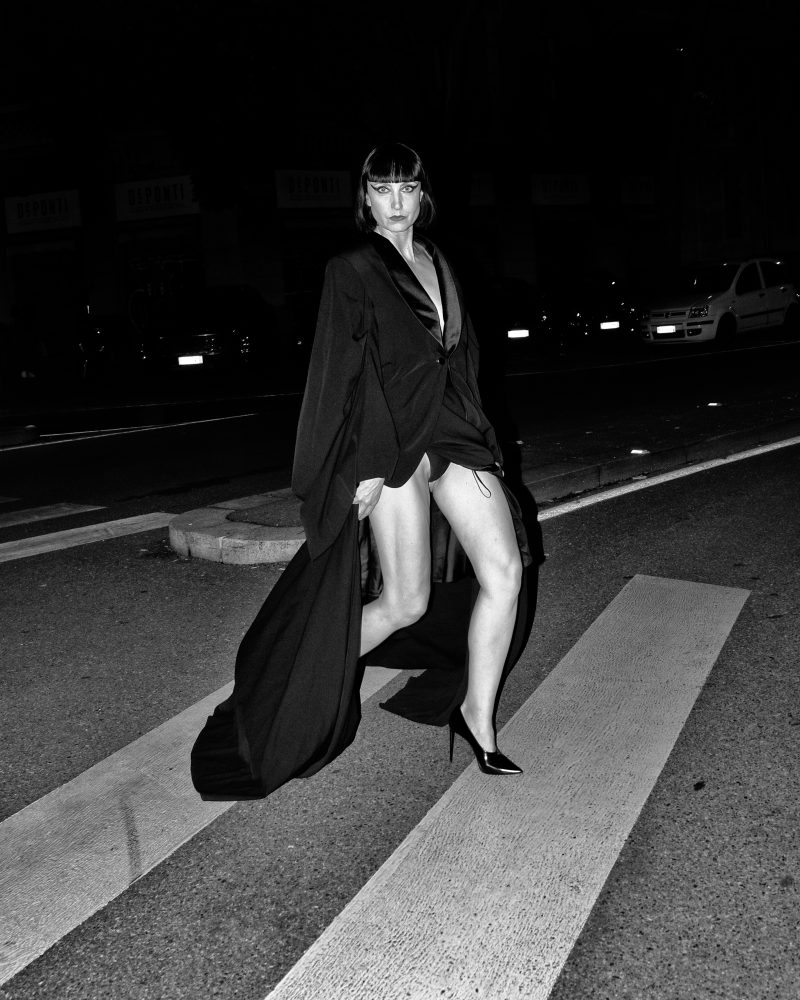
WB: I grew up in a very old English bohemian family. A lot of my textual references and color references often come from what you might connect with that kind of old bohemia— velvets and satins. Then, there’s also the theatricality, film, theater. I grew up surrounded by that. I love using lost language, juxtaposing that against something new. That universe is a place that I feel has a lot of texture and a specific light. Shadow is quite important in my work, too— the theatricality of light and dark.
“I put things together as a bit of a jigsaw puzzle.”
DW: How did you discern what constituted sonic resonance for you? You’ve played instruments since you were young. How did this current sound that you’re experimenting with come together?
WB: I’m really experimental with the way I play. The violin is a tough instrument. I’ve never been a classical musician, and I don’t claim to be. I just can play the violin, so I decided to become more experimental with it, and use it as an artist. I explore soundscapes and use pedals to create that identity. Those sonic textures come from strings, synths, and vocal stacking. When it all comes together, that’s the dream.
DW: Talk to me about your upcoming album. Where did you source inspiration from this project?
WB: This album was written over a period of years. The first session I did was just before the pandemic, so it had to be put to one side during that period of time. It’s been a long journey. This is my second solo album as an artist. I’m very proud of it. As a body of work, it represents me significantly as an artist, and I hope that it’s a place for people to listen, dream, and feel that they have another space to enter when they listen.
DW: Explain to me your process. There are many layered vocals, instrumentals, and violin involved in your tracks. How does a single song come together?
WB: Lyrics will come to me. I’ll think of one line, and collect all these ‘one lines’. I put things together as a bit of a jigsaw puzzle. I read a lot of really old poetry. A great joy of mine is finding random, old poetry books, and being inspired by that use of language. In the studio, we find a feeling or a melody that I like, then I’d write around that. It’s about building these ideas up, so no one song is ever the same.
“A lot of my textual references and color references often come from what you might connect with that kind of old Bohemia”
DW: You’ve been playing big festivals recently, sharing the stage with Duran Duran, and snagging features in a few exciting lineups. How has that performance experience differed from your typical gig?
WB: I played British Summer Time, supporting Scissor Sisters and Duran Duran. It was an amazing day. In terms of experiences, that was definitely a top one. As far as future performances go, the album came out the 18th of September, so I’m lining up quite a few things through the new year.
DW: You have such a distinct way of expressing yourself. Talk to me about how your personal style has evolved.
WB: My personal style has transcended over the years. I mean, I just love fashion. I don’t really buy things. I never throw anything away. I’m a really big collector, and I’m very passionate about that. I love quality, meaning the materials and the identity you embody when you’re wearing something. Putting that together becomes your unique imprint, and that really excites me. I think it comes back to my grandfather. His first wife was one of the first female fashion historians. She opened a museum featuring her collection. My grandfather was extremely involved in that because my grandparents were involved in the wool trade back in the day. Fashion has always been in my family. I dressed in a more bohemian way when I was younger, and now I’m more focused on elegance. One of my favorite labels is Dries Van Noten, and always has been. They perfectly convey that sophistication with an edge.
“Shadow is quite important in my work.”
DW: With this talk of fashion, is there ever an interest in crossing over industries? You’re also an accomplished photographer. How do you see your creativity blossoming beyond songwriting?
WB: Much of my focus is on music these days, but I anticipate getting back into shooting again at some point. It’s very important to be true to your crafts. I’d like to imagine I end up having my lyrics published in a poetry form. I’ve been dreaming about that old salon idea of bringing people together, and I feel like literary readings are having a comeback, so I’d love to bring my lyrics to life in that way. I want my creative world to be ever-expansive.